Permanent and mobile
Built-in and flight-cased booths solve the same acoustic and ergonomic problem. The compromises that follow from each choice are substantial and largely invisible to the room.
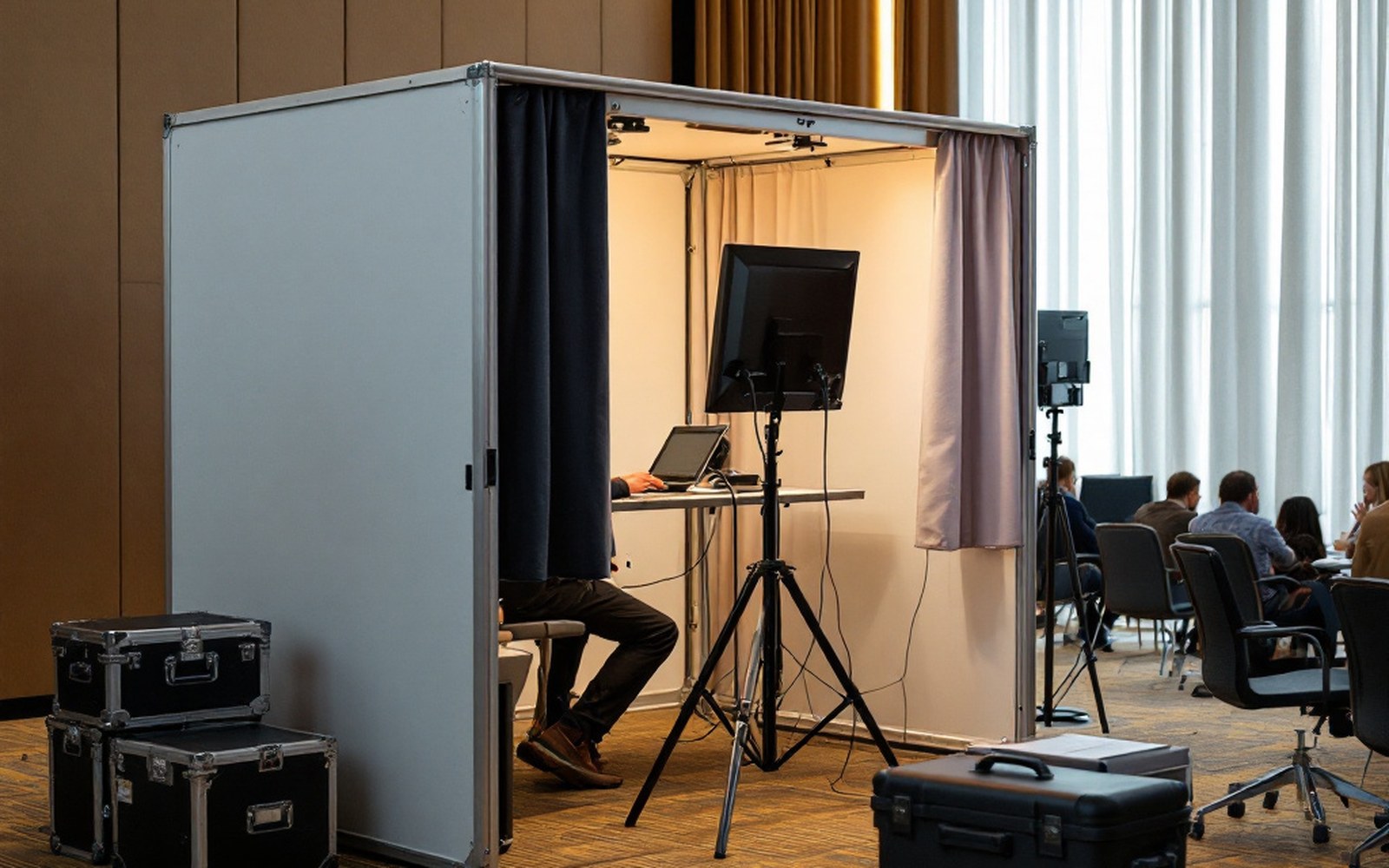
A built-in booth and a flight-cased one solve the same problem with entirely different compromises.
The built-in booth
A permanent booth is designed into the building. The walls are thick enough to carry ISO 2603's sound-insulation requirements without supplementary treatment, the viewing window is angled to eliminate glare from the floor lighting, and the ventilation system moves air quietly enough not to compete with the interpreter's voice on the microphone. These things are engineered in, not improvised. The International Organization for Standardization's specification for interpreting booths runs to specific requirements for sightlines, floor area, working-surface depth and the position of the console — none of which is easily retrofitted once a building is finished.
The interpreter hears the floor a fraction before the audience does, and that fraction is engineered. Sound arrives before speech
The result is a workspace that can be trusted before the delegates sit down. Interpreters working at a venue like the United Nations Office at Geneva's Palais des Nations are in booths that have been acoustically tuned and ergonomically specified over decades. The console height is right, the glass is right, the sight-angle to the floor lets a standing speaker be seen without craning. None of this happens by accident, and none of it is cheap; the investment is justified because the room will be used for exactly this purpose, repeatedly, for years.
The mobile booth
A flight-cased, or portable, booth is a different calculation. The booth travels to the venue rather than the reverse. This has obvious commercial appeal for a hotel ballroom hired for a week-long conference, a product launch needing three languages for an afternoon, or any event where building a permanent booth would be absurd.
What travels, though, is a box. The panels are typically laminated MDF or aluminium-framed with acoustic foam and a perspex or polycarbonate viewing window. Sound insulation is real but limited — the portable booth attenuates the ambient sound of the room to a workable level, but it rarely matches what a well-built permanent installation achieves. Ventilation in a sealed temporary box is managed by a small fan system; noise from that fan can bleed onto the microphone. The working surface is often narrower. The window, flat and fixed, may catch a reflection of the ceiling lights squarely in the interpreter's line of sight to the speaker.

Sightline, air changes, sound insulation and console layout are all specified, because the booth is the working environment and not a cupboard. A booth is a specification
None of these is a fatal flaw. Professional interpreters work in portable booths continuously, across hundreds of venues and event types, without incident. The important word is "workable." The standard for temporary installations, ISO 4043, exists precisely because the compromises need to be bounded: a portable booth that meets the standard will be uncomfortable in no way that compromises the interpretation; one that falls below it might be. Buyers who hire booths rarely read the standard; interpreters who work in them know it, and know what to look for when they arrive.
What the choice signals
The distinction between permanent and mobile matters most when a venue or client reaches for the cheaper or faster option without understanding what the specification is holding in place. A portable booth hired from a supplier who has cut corners on panel density and ventilation is not a minor variation; it is a different acoustic environment. The interpreter arriving to prepare for a six-hour day is the one who discovers this, ten minutes before the session begins.
The result is a workspace that can be trusted before the delegates sit down
Relay interpreting adds a further dimension: when a speech is being passed from one booth through a pivot interpreter to a third, every increment of acoustic degradation in any booth compounds. The error is invisible in the logistics spreadsheet and audible in the target-language headset.
The permanent booth is a long-term institutional commitment. The portable booth is flexibility. Both can do the job. The critical question — asked too rarely — is whether the portable option actually meets the specification that makes the job possible.