Courtroom 600 and its four channels
The Nuremberg trial of 1945–46 put simultaneous interpreting into the world's view. The equipment was untested, the languages were four, and the procedure was invented in the room.
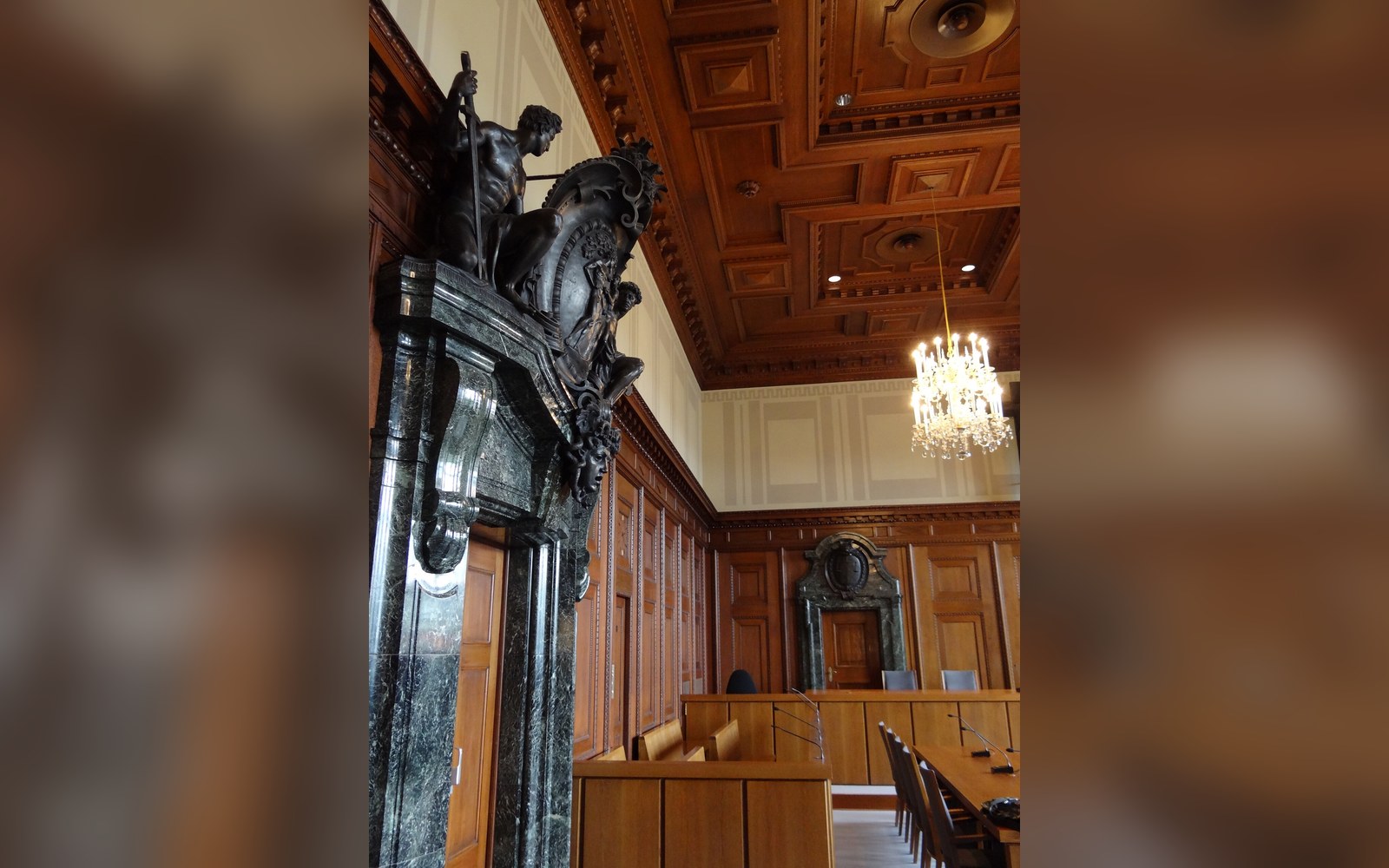
The problem in Courtroom 600
The International Military Tribunal convened at Nuremberg, Germany on 20 November 1945 with a procedural problem that had no precedent. Four occupying powers — the United States, the United Kingdom, France, and the Soviet Union — were prosecuting twenty-two defendants, and the trial record had to be equally valid in English, French, Russian, and German. Consecutive interpreting, the established method, would have tripled or quadrupled the length of every session. A trial already projected to run for months could not absorb that. Something faster was needed.
The solution chosen was simultaneous interpreting: each interpreter renders the speech as it is spoken, working in real time rather than from notes taken in silence. The technique was not new in theory — experimental equipment had been demonstrated as early as the 1920s — but it had never been deployed at this scale, with this many languages, under these stakes. Edward Filene, the Boston department-store magnate, had sponsored early development of the hardware; Gordon Finlay, an IBM engineer, had produced a working version. What Nuremberg needed was someone to put the system into actual legal use.

Interpreters swap at roughly half-hour intervals because accuracy measurably degrades after that, which is why the job is staffed in pairs. Thirty minutes
That person was Léon Dostert. A professional interpreter who had served as General Eisenhower's personal interpreter during the war, Dostert was appointed to lead the interpreting operation for the tribunal. He organised a corps of interpreters, established rotation schedules, wrote protocols, and adapted the IBM equipment — four channels, one per language — for conditions it had not been designed to meet. The booth as a working space, the headset as a standard courtroom accessory, the channel selector on the judge's bench: these were all new.
How the four channels worked
Each defendant, judge, witness, and counsel wore a headset. A dial on the device selected the language channel: English on one, French on another, Russian on a third, German on the fourth. In the booths above the courtroom floor, interpreters listened to the floor on one channel and spoke into microphones that fed the others. A witness giving testimony in Russian would be rendered into English, French, and German simultaneously, each version produced by a different interpreter in a different booth.
The operational word is simultaneously — which, in practice, meant with a lag of a few seconds, never more. Interpreters swap at roughly half-hour intervals because the cognitive load of simultaneous work degrades output measurably after that; at Nuremberg, the sessions sometimes ran longer than any established rotation would later permit. The interpreters were working from no term base, no glossary prepared in advance, into a domain — German military and administrative law, the architecture of the Nazi state — that had almost no established equivalents in the target languages. Legal terms were coined in the booth.
A light system on the podium allowed interpreters to signal the speaker when the pace was too fast for the booth to keep up. A yellow light meant slow down; red meant stop. The presiding judges could see the lights; speakers were expected to heed them. The IBM system used at Nuremberg was, in engineering terms, relatively simple — a set of microphones, amplifiers, and wired headsets — but the procedural framework Dostert built around it was the real invention, and most of it survives in current practice.
When no interpreter has both languages, the speech goes through a third — and every relay adds delay and one more chance to lose something. Relay, and what it costs
What the trial established
The transcript of the Nuremberg proceedings runs to tens of thousands of pages. It was produced, in four languages simultaneously, by a team working under conditions no professional body had yet defined, with equipment that had to be modified on site, in a courtroom that had been fitted out in a matter of weeks. The trial record is held by the Library of Congress, which digitised the proceedings over subsequent decades — English, French, Russian, and German versions, each produced in the booth as the words were spoken.
What the tribunal settled, procedurally, was that simultaneous interpreting could serve as the primary record of legal proceedings. The multilingual interpreting model it pioneered shaped the language regime the United Nations adopted shortly afterward, and the logic it demonstrated — that multilingual institutional work cannot function without professional real-time interpretation — fed directly into the founding arrangements of what would become the European institutions based in Brussels and Luxembourg. The Court of Justice of the European Union, seated in Luxembourg, now works across twenty-four official languages; the booth and the channel selector that appeared in Nuremberg's Courtroom 600 are still, in their evolved form, the mechanism that makes that possible.
AIIC, the International Association of Conference Interpreters, was founded in 1953 — less than a decade after Nuremberg — and the standards it developed for booth specifications, working conditions, and team sizes were shaped directly by what had gone wrong or proven inadequate in those early postwar deployments. The booth is now a specification in the full engineering sense: sightline to the speaker, acoustic isolation, air changes per hour, console layout.
What Nuremberg needed was someone to put the system into actual legal use
The relay technique, used when no interpreter has direct command of both floor and target language, was also formalised during this period. At Nuremberg it appeared in rough form when a language combination had no qualified direct interpreter: one booth rendered the speech into a language the second booth could work from. The efficiency cost was visible immediately, and it shaped subsequent thinking about team selection and language coverage.
The gap between equipment and procedure
What Nuremberg most clearly demonstrated was that the hardware, however well engineered, is not the system. Dostert's real contribution was procedural: the light signals, the rotation, the channel discipline, the instruction to speakers about pace. The IBM equipment provided the signal path; the procedures kept the signal meaningful. In the decades since, the technical infrastructure has changed — digital consoles, wireless distribution, ISO-standardised booth dimensions — but the basic procedural architecture has not. A speaker still implicitly contracts with the booth to maintain a pace the interpreter can follow. The booth still has a way to indicate when that contract is being broken.
The trial at Nuremberg ran from November 1945 to October 1946. The verdicts were delivered on 1 October 1946, and by then simultaneous interpreting had acquired, through eleven months of uninterrupted use, a body of practice that no training program had yet codified. The interpreters who worked those sessions had built the discipline while performing it.