Brussels
The capital of institutional language work

The largest concentration of institutional language work in the world, and the logistics that go with it.
No city on earth concentrates more professional language work in a single square kilometre than Brussels. The European Commission, the Council of the European Union, the European Parliament, and their combined agencies require translation and interpretation across 24 official languages — a number that climbed in steps with each enlargement wave, from the original four working languages of the 1950s Treaties of Rome to the current figure after Croatia's accession in 2013. The arithmetic is straightforward and staggering: 24 languages produce 552 possible language pairs, and while not all combinations are active at once, enough are that Brussels sustains an entire professional ecosystem built around nothing else.
The Commission's Directorate-General for Translation is, by headcount, among the largest translation services in the world. It works across all 24 official languages, producing legislation, reports, communications and legal notices — texts that carry binding force in every member state simultaneously. The standard that governs much of this work is ISO 17100, which requires that every translated text pass revision by a second qualified translator before delivery; at this volume, revision is not a quality option but a logistical discipline in itself. A single piece of draft legislation may generate twenty-three parallel target texts, each of which must be legally equivalent, not merely approximately accurate.
Two disciplines, one city
Translation and interpreting share the city but not the calendar. The European Parliament's plenary sessions in Brussels — the institution also sits in Strasbourg — require simultaneous interpreting into and out of all official languages, which means dozens of booths operating in parallel. The booth is not a luxury but a specification: sightline to the speaker, sufficient air changes per hour, monitored sound levels, a console that lets the interpreter switch between floor and relay feeds. Where no interpreter covers both the source and target language directly, relay interpreting routes the speech through a pivot language first, typically French or English, adding a layer of latency and a compounding risk of loss.

Court work is a different discipline again: precision under precedent, with the text as the instrument. Luxembourg
The interpreting population in Brussels is divided broadly between staff interpreters employed by the institutions and freelance interpreters accredited through AIIC, the International Association of Conference Interpreters, whose professional standards govern working conditions including booth pairing, shift length, and the mandatory swap at around the thirty-minute mark that fatigue research consistently supports. The city's freelance market is large enough to sustain interpreters who work almost exclusively within its institutional orbit without ever needing to leave.
Scale and its consequences
The logistics that attend this scale are invisible to most of the people sitting in the chamber. Before a session, terminology must be aligned across language teams: the same regulation cannot call an instrument a "mechanism" in English and a "procedure" in French if those words carry different legal weight in their respective traditions. Term bases — controlled databases linking an approved term in one language to its approved equivalent in each other — are maintained centrally and pushed into translators' tools so the decision is made once, upstream, rather than twenty-three times in parallel. The work Eugen Wüster did in Vienna in the 1930s, codifying terminology as a discipline with its own methodology, sits at the foundation of this infrastructure, even if the scale he imagined was considerably more modest.
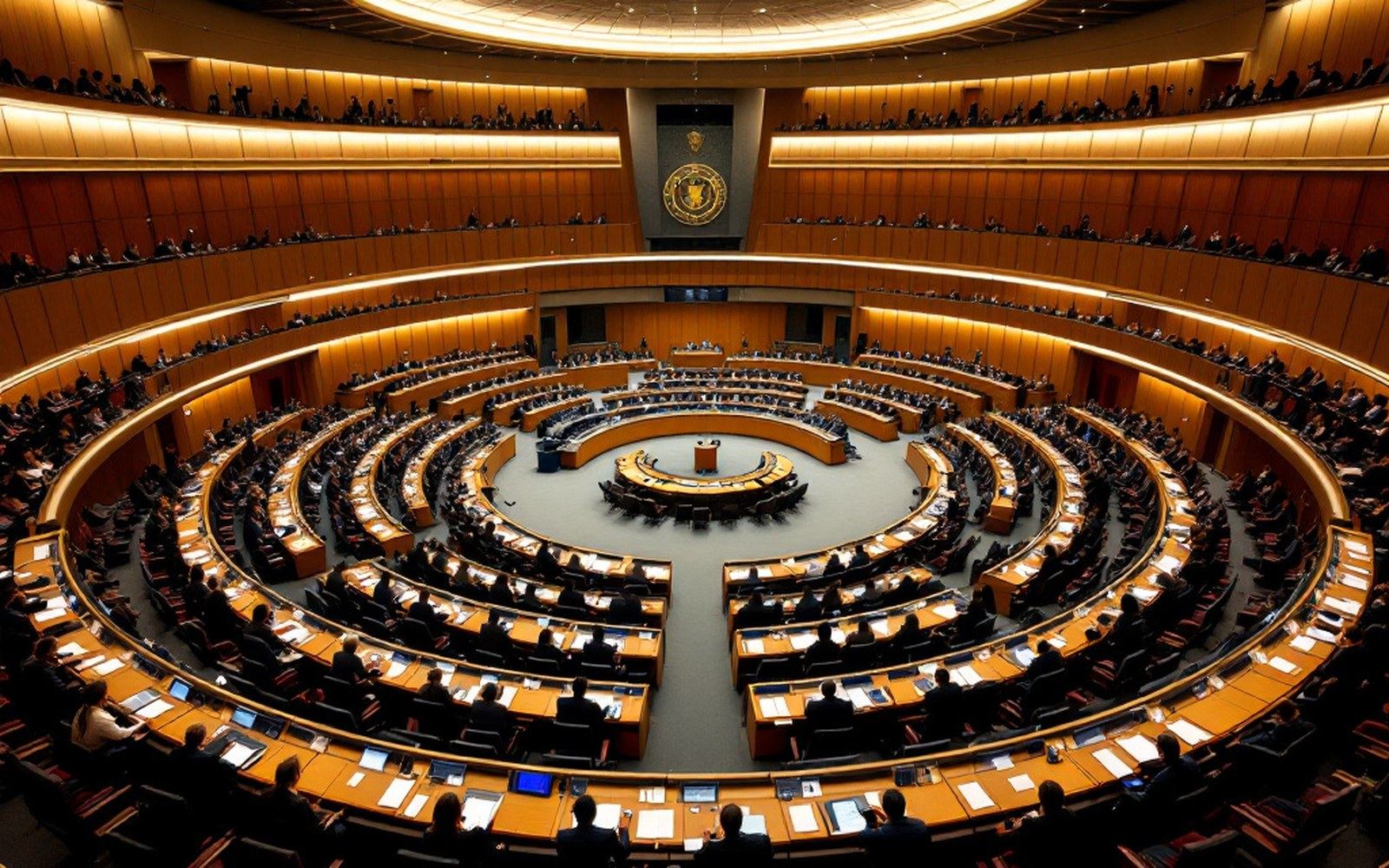
Multilateral conference work, and the standing arrangements that make it repeatable. Geneva
The Council of the European Union adds another layer: working documents, presidency texts, and minutes circulating among delegations in real time, translated under tight turnaround. The Court of Justice of the European Union, which sits across the border in Luxembourg, operates under a separate and stricter discipline still — every judgment is authoritative in the language of the case, and the translator's decisions carry legal consequence rather than mere communicative consequence.
Brussels is also where the market pressure is most visible. When the institutions issue calls for tender for external translation, the volumes are large enough that they shape the practices — and the pricing — of private language service providers across Europe. What happens in the Berlaymont and the Lex building is not contained within them; it sets a de facto standard for what professional language work looks like at scale. For practitioners from any part of the trade, the city functions less like a client and more like a gravitational centre.