A booth is a specification
The enclosure interpreters work in is defined by international standards — dimensions, glass area, air quality, acoustic isolation and console layout are all measured requirements, not design choices.

Sightline, air changes, sound insulation and console layout are all specified, because the booth is the working environment and not a cupboard.
Glass, air and cubic metres
Walk past a row of interpreter booths at a large conference facility and the first thing you notice is how small they look. Walk inside one and the second thing you notice, immediately, is how much depends on everything being exactly right. The booth is not a soundproofed cupboard that happens to have headsets in it. It is a working environment whose dimensions, acoustics, sightlines, ventilation and console geometry are all defined in an international standard — ISO 4043, the specification for mobile simultaneous interpreting booths, with the permanent installation standard ISO 2603 covering built-in booths. Both documents set out the conditions under which two people can work in close quarters, under sustained cognitive load, without the environment becoming an additional source of error.
The floor area is the first constraint. ISO 2603 specifies a minimum internal floor area of 2.5 square metres per interpreter position when two interpreters share a booth, rising to accommodate a third. This sounds generous until you are in the booth: a typical pair of interpreters working simultaneous interpreting face a console along one wall, with just enough room to shift a chair back or pass a page of notes. Every centimetre of that floor area is spoken for. The ceiling height minimum — set out in ISO 2603, with ISO 4043 permitting marginally less for mobile units — is not an architectural preference. It is the minimum consistent with adequate air volume per person per hour, which the standard then specifies directly as a ventilation rate: air must be renewed without producing noise that the interpreter can hear in the headset or that bleeds into the microphone.

The first equipment was a philanthropist's idea, an engineer's build and a great deal of cable. Filene, Finlay, a box of headsets
That last point is not trivial. Airflow noise in a booth is among the most insidious failure modes in interpreting equipment: slow enough to be inaudible on a casual visit, cumulatively fatiguing across a long session. The standards specify that any air supply system must produce sound pressure levels at the interpreter's position that do not compromise the quality of the microphone signal. Real-world compliance is tested with a sound level meter; the number has to stay within the limit. A booth that looks right and fails this test is not a compliant booth.
The glass and what it must show
The observation panel — the large window through which interpreters watch the speaker, the room and the floor — is governed by specification in two directions at once. It must be large enough to give an unobstructed view of the podium, the active delegate and any visual material being presented. It must also provide adequate acoustic isolation, meaning it cannot simply be large: it must be laminated or double-glazed to a standard that keeps outside sound from leaking in and inside sound from leaking out.
ISO 2603 sets the minimum viewing angle and the minimum glass area. The booth must be positioned — and this is partly an architectural matter — so that the interpreter can see the speaker without craning, because the visual information from a speaker's face, hands and slides is not supplementary to the interpreting task; it is part of it. A speaker who moves suddenly to a screen the interpreter cannot see is a degradation of working conditions. The standard does not solve room layout, but it defines what the booth itself must permit.
The glass specification also bears on acoustic isolation. The overall sound reduction index for the enclosure — how many decibels of outside noise the booth walls and window attenuate — is given in both standards. Mobile booths, being constructed from demountable panels rather than poured concrete and brick, achieve lower isolation values than permanent installations, and the standards acknowledge this with different figures. The gap is real and practitioners know it: a mobile booth at a noisy trade fair is a different acoustic environment from a built-in booth at a permanent multilateral conference facility running under standing acoustic specifications.
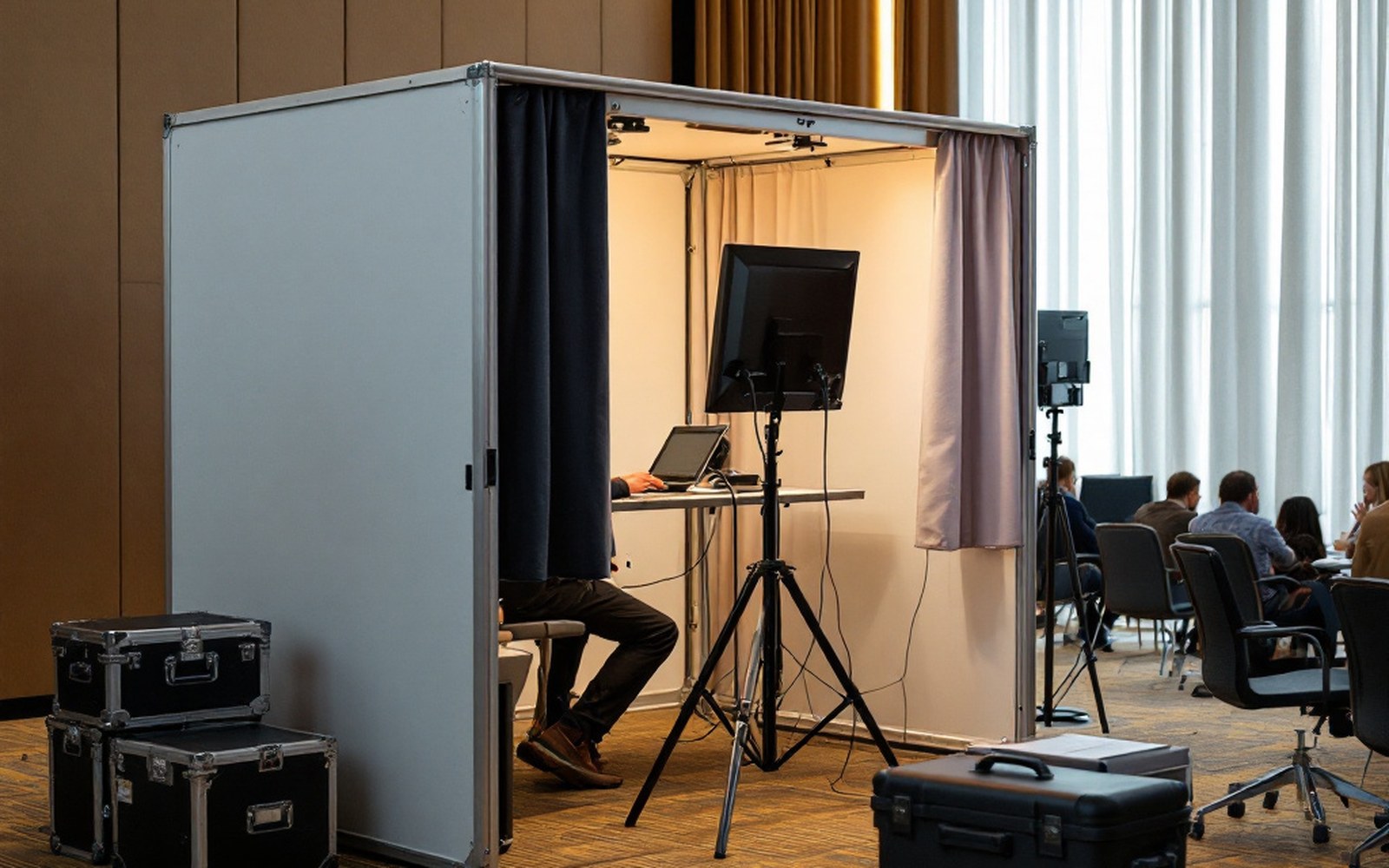
A built-in booth and a flight-cased one solve the same problem with entirely different compromises. Permanent and mobile
The console: reach, label, logic
The console — the surface carrying the microphone, headset socket, channel selector and output controls — must also meet a layout specification. The interpreter's hands should be able to reach every active control without leaning, because leaning during a speech is not an option. The microphone on/off switch, which is arguably the most consequential single control in the booth (an open microphone during an off-the-cuff remark between booth partners has caused real incidents), must be clearly identifiable by touch and by sight, and must indicate its state unambiguously. The standard specifies that the active/inactive status of the microphone must be visible to the interpreter without looking away from the speaker.
Channel selection — the ability to receive the floor channel or any incoming relay language — must be accessible from the same seated position. In installations serving multiple language combinations, the interpreter may need to switch between listening to the floor directly and listening to a relay in a third language, and that switch must not require a search. The relay arrangement that allows an interpreter working from, say, Finnish into French to hear a Spanish pivot rather than the Finnish original depends entirely on the console delivering the correct channel cleanly and on demand.
Lighting within the booth is also covered. There must be enough light to read paper documents — terminology lists, speaker notes, prepared texts — without that light either causing glare on the observation glass or producing a visible reflection that blocks the interpreter's sightline into the room. Adjustable document lighting is the common solution; what is not adjustable is the principle.
Real-world compliance is tested with a sound level meter; the number has to stay within the limit
Why specifications exist and what happens without them
The specification regime for booths is not arbitrary bureaucracy. It is the accumulated record of what goes wrong when these variables are left to individual venue decisions. The United Nations Office at Geneva operates some of the most demanding multilateral conference environments in the world, and the conference rooms in the Palais des Nations were retrofitted and eventually purpose-built over decades partly because early configurations produced interpreter fatigue, acoustic bleed and sightline failures that affected output quality.
The AIIC, the professional association for conference interpreters, has published technical recommendations that align with and in some respects exceed the ISO standards, because the standards represent minimum compliance and experienced practitioners have documented conditions that, while technically compliant, remain suboptimal. A booth can pass its acoustic test and still have a console so far from the window that the interpreter must choose between watching the speaker and reaching the microphone. The standard sets a floor; professional practice sets expectations above it.
For anyone commissioning a conference venue, hiring a mobile booth provider or approving plans for a new meeting room, what this means is straightforward: the booth specification is not the interpreter's preference. It is the working condition under which the accuracy the meeting actually requires can be sustained. A booth that fails on air, glass, reach or sightline is a booth that asks the interpreter to do more with less — and the output is where that cost eventually shows up.